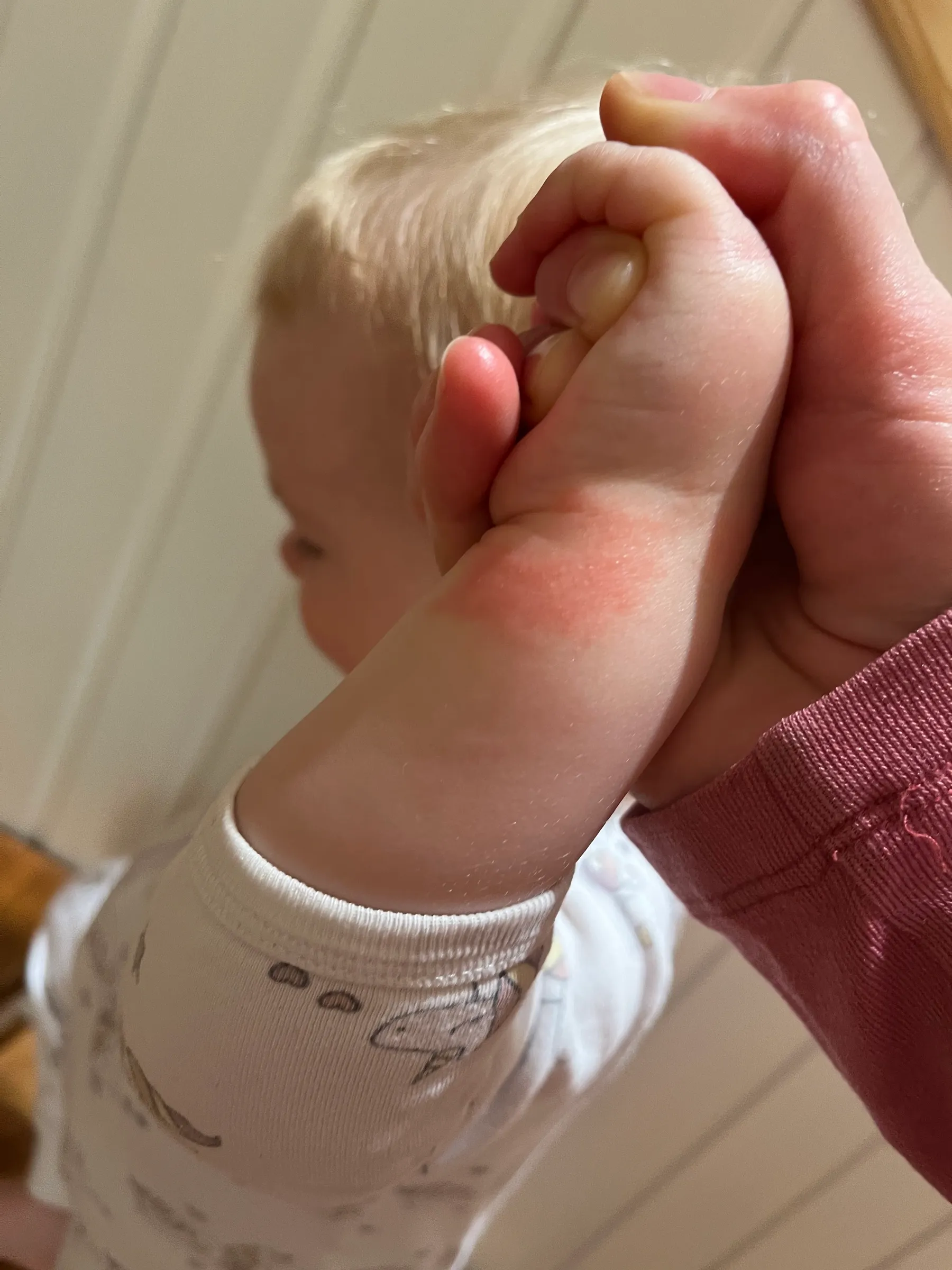
A persistent struggle
My son has struggled with mild but persistent eczema since he was around 4 months old. I have spent many hours trying to identify the likely numerous factors contributing to this, as well as various ways to heal his dry, red skin. After I implemented many of these approaches with substantial success (which I will talk about another day), his skin reached the point where it was entirely clear when he was at home, but the dry, red patches would return immediately when he went to daycare. Nothing I tried seemed to help - until now. And it happened quite by accident.
An unexpected change
My son is now nearly two years old, and I am still nursing him. I am also 26 weeks pregnant. He hasn’t been getting a whole lot of breast milk for the last couple of months because my supply has decreased during pregnancy, but in the last two weeks, I have started to make quite a bit of colostrum - enough that I can hear him swallowing it. As soon as I noticed the change in my milk, his skin started clearing up, and now, after two weeks, I can’t find any red patches at all. I hypothesized that this sudden positive change in his skin health was due to his sudden access to my colostrum.
Looking for an explanation
Being the researcher I am, I went to Google Scholar to see what I could find on this topic. While there is a lot of research on colostrum, even human colostrum, and its effects on numerous infant health outcomes and some longer-term health outcomes, there is very little research on the effects of consuming colostrum of any sort (human, bovine, etc.) on skin health in people beyond infancy. I did find one study, published in 2025, examining the effect of colostrum (in this case, bovine colostrum extracellular vesicles) on atopic dermatitis in mice. The results of this study suggest that my observation with my son may not be a coincidence.
What the mouse study examined
The study, published in May 2025, examined mice with experimentally induced atopic dermatitis. There were four groups of five mice: a control group without experimentally induced atopic dermatitis, a group with experimentally induced atopic dermatitis that received a placebo treatment, and two groups with experimentally induced atopic dermatitis that were treated either orally or topically with extracellular vesicles derived from bovine colostrum.
Improvements in skin and inflammation
First, the mice with experimentally induced atopic dermatitis that did not receive the bovine colostrum extracellular vesicle treatment indeed displayed increased skin inflammation as well as decreased body weight. In contrast, the groups of mice treated with bovine colostrum extracellular vesicles showed improvements in measures of skin inflammation and normalization of body weight compared with the untreated atopic dermatitis group. Further, the improvement occurred much faster in the orally treated group than in the topically treated group.
Bovine colostrum extracellular vesicle treatment modulated the immune response. The number of mast cells in the skin, as well as concentrations of serum IgE and histamine, were measured in the control and treatment groups. In the atopic dermatitis group treated with bovine colostrum extracellular vesicles, the number of mast cells in the skin and the serum concentration of histamine did not differ statistically significantly from those in the group without atopic dermatitis. Serum IgE remained elevated but was significantly reduced compared with that in the untreated atopic dermatitis group.
Likewise, the expression of genes related to the immune response (Tnfa, Il4, Il13, and Fcer1g) was significantly increased in the untreated atopic dermatitis group, but not in the group treated with bovine colostrum extracellular vesicles. The expression of profilaggrin, an essential component of the skin barrier, was significantly lower in mice with atopic dermatitis than in those without it, but expression almost normalized in the group treated with bovine colostrum extracellular vesicles.
Changes in the gut microbiome
The researchers also examined the effect of extracellular vesicles derived from bovine colostrum on the gut microbiome using metagenomic sequencing, since the gut microbiome is closely tied to the function of the immune system. Using the weighted UniFrac distance metric, which takes into account both the presence and abundance of microbes, they found that the mice treated with bovine colostrum extracellular vesicles clustered with the mice without atopic dermatitis, while those with atopic dermatitis that did not receive the treatment formed a distinct group.
Specific bacteria in the guts of the mice studied also differed depending on the presence of atopic dermatitis and the treatment received. Compared with untreated mice with atopic dermatitis, mice with atopic dermatitis treated with bovine colostrum extracellular vesicles notably showed increased abundances of Lactobacillus and Faecalibacterium and decreased abundances of Corynebacterium and [Clostridium] methylpentosum group. This pattern is consistent with beneficial effects of bovine colostrum treatment on the gut microbiome, although it is important to keep in mind that with each mouse group containing only five mice, the statistical power to detect differences in abundances of gut microbiota is quite limited. This means that there are likely far more differences between these groups than are able to be detected.
Metabolites tell a more complicated story
They next assessed the profile of metabolites in the gut of each group of mice, and found that the control mice without atopic dermatitis, those with atopic dermatitis and placebo treatment, and those with atopic dermatitis that were treated with bovine colostrum extracellular vesicles clustered into distinct, non-overlapping groups. In particular, maltose, d-glucose, and d-galactose increased significantly following bovine colostrum extracellular vesicle treatment. This suggests that while treatment with bovine colostrum extracellular vesicles changes the gut metabolome, it does not appear to restore it all the way to baseline, at least not across the board. Some specific metabolites, such as lactic acid, which was decreased in the placebo-treated atopic dermatitis group but increased in the bovine colostrum extracellular vesicle treatment group, do normalize.
Worth a try
Although this is a small animal study, it provides clear experimental evidence that components of colostrum could directly affect the gut microbiome, immune system, and ultimately the severity of atopic dermatitis. Given that consuming colostrum as a supplement (or in my son’s case, continuing to nurse throughout my pregnancy - which he was doing anyway) has a low risk of deleterious side effects, it makes sense to me to try it out if you or your child is suffering from this condition. Of course, the etiology of atopic dermatitis is complex, and this may not work for everyone. Additionally, approaching the problem from a holistic standpoint, including through diet and environment, is likely to yield the best results.