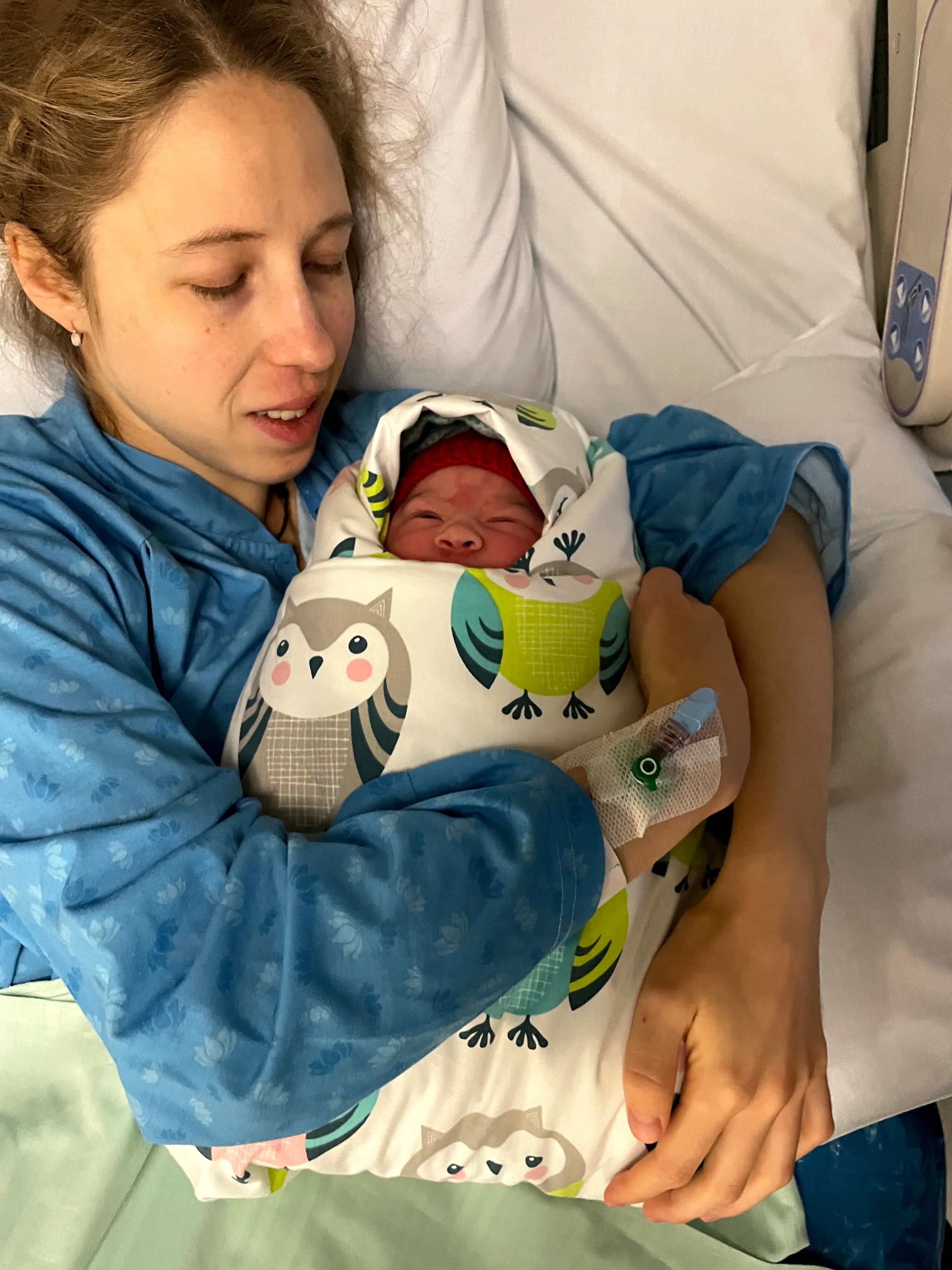
As I lay in my bed after a long and emotional day, the moment I had been waiting for finally arrived. First one contraction, then another, and another—all five minutes apart. I could hardly believe it. At nine days past my due date, I had finally given up hope of ever going into labor. Apparently that was the key.
Waiting for Labor
Throughout my entire pregnancy, everyone thought I would have my baby on the early side (yes, I know everyone thinks that). Both my mom and my sister have three children, and none of them ever made it past their due date. So, I assumed I would be the same. I could not have been more wrong.
My due date came and went. At first I was surprised, but figured it would start soon. I certainly was having a lot of contractions—every few minutes—and had for the last several months of pregnancy. It’s just that none of them were doing anything. The days went by, one by one, and I became increasingly distressed.
As an epidemiologist, I was familiar with the literature on the risks of staying pregnant too long, and my mind started going crazy. In Finland where I live, they don’t generally recommend induction of labor until 41 weeks and 5 days gestation, unless there is a medical indication. Since there was none, I was out of luck (as I felt at the time—my views on this now could not be more different).
I did not want to be induced, but the fear of something happening to my daughter had taken over. This being my first child, I had ample time to ruminate on all the things that could happen and did not have the benefit of other responsibilities to distract me. I tried everything. Pumping and collecting colostrum (I ended up with two gallon-sized bags full of 2.5–5 mL syringes, most of which are still in my freezer five years later), Spinning Babies, walking and walking and walking some more. The only thing I did not manage to do was relax because I was so stressed out.
Finally, I was able to secure an earlier appointment at the hospital to check on my baby, for the morning of 41+3. Immediately, I felt better. I baked zucchini bread. We enjoyed a delicious dinner. And, promptly after laying down in bed around 11 pm that night, I started having contractions.
Labor Begins
At first I thought it was a fluke. But, they were coming every five minutes like clockwork, and definitely felt different than the unrelenting Braxton Hicks contractions I had been having for the last 27 weeks. Still mild, but I could tell something was different. After I felt certain they were continuing, I told my husband. We both felt a sense of excitement at the thought that we would soon get to meet our daughter.
Immediately, my husband called the hospital birthing unit. In Finland, you don’t get to know beforehand which hospital you are sent to. It depends on how busy each one is on that particular day. I was hoping to be able to go to the nearest hospital (about 40 minutes away), which also happened to be the smallest (with only three birthing rooms) and most well-liked due to the positive attitudes of the midwives and doctors who worked there, and their support of natural birth.
I was relieved to hear that it was a quiet night, despite the baby boom of Summer 2021. The midwife encouraged me to have a bath to see if my contractions would continue, so me and my husband excitedly filled the tub, lit some candles, and spent the next several hours timing contractions (as an aside, I would not recommend this approach to labor to ANYONE, but more on that later).
By around four in the morning my contractions were around four minutes apart and maybe a little stronger than they had been. I started feeling tired and decided I should try to sleep. However, laying down felt horrible, and there was no way I was going to be able to sleep. The appointment I had scheduled at eight o’clock in the morning at the big hospital in Helsinki was looming over me, and I decided that maybe we should go to the hospital sooner rather than later to make sure we were able to go to the closer, smaller one.
Arriving at the Hospital
Up until this point I had been calm and happy. As soon as we started driving, however, I began to feel extremely nervous. So nervous that my teeth were chattering and my whole body was shaking. I do not like hospitals, or really any medical setting, and feel extremely uncomfortable there. About halfway to our destination, I knew we were making a mistake and we should have stayed home longer. I was well versed in birth physiology, and knew that this kind of disruption could completely stop whatever was starting to happen. And indeed, my contractions had started to space out to farther apart than they had been even at the very beginning—and they were markedly less intense. But I felt that if we returned home, we would then have to almost immediately begin driving to Helsinki for my scheduled appointment. So we continued.
You might be wondering why, if I am so terrified of hospitals, I was planning to give birth in one—I had always planned on giving birth at home when I was younger, and my original career plan as a high schooler was to be a homebirth midwife. The short answer is that, at the time, I did not know that giving birth at home was even an option in Finland. Additionally, I felt somewhat comforted by the fact that midwives are in charge of all normal births here, and the rates of most interventions are far lower than in the US where I grew up. I thought that was enough, especially given that I was under the impression that it was the only option.
When we arrived at the hospital, the contractions I had been having had all but disappeared. The midwife told me I was only two centimeters dilated, and seemed to doubt that anything at all had been happening at home. However, since I was supposed to have an appointment that morning anyway, they decided we could just do the appointment there instead of sending us to Helsinki. I felt defeated, embarrassed, and exhausted after being awake the whole night.
While we waited, I was still having contractions—annoying enough that I still could not sleep—but only around ten minutes apart. I was hooked up to the CTG, wearing a mask, and cold and clammy. Most of all I was so tired, which worried me most of all since I knew I had a long way to go.
After around an hour, they brought us to another room where they did an ultrasound, and then proceeded to recommend various methods of induction since I was “already so overdue.” I asked why could I not just go home, rest, and wait for things to pick back up since they had already started? While they didn’t tell me that I couldn’t do that, they were very keen on just moving on to the next step and I was too tired to fight it.
The Foley Balloon
They convinced me to use the Foley balloon, telling me ironically that I could even go home until it fell out, which should be in about twelve hours. I did not even make it down the hallway before I was hit with the most painful contractions I have ever experienced (and at this point, in the future, I have had two additional births, at HOME completely unmedicated). I was not going anywhere, however they could (would) not admit me as a patient because I was “not in active labor.” So they stuck me in a triage room. I really needed to pee, but every single time I tried sitting down I immediately had another contraction and had to stand up. Every time I moved I had another one, even if one just ended. After trying to sit down on the toilet several times, I fainted. I came to on the floor, very confused for a moment.
I gave up and laid as still as possible on the bed instead. For two hours I stayed there, unable to move. My husband sat helplessly next to me, trying his best but unable to get me to do much of anything. Finally the midwife came back and asked if I’d been pulling on the catheter like I was supposed to. I had not. I could not. But, surprise! When she pulled on it, the whole thing plopped right out, only about 2.5 hours after it had been inserted.
Everyone seemed surprised by this, except for me. “Minor cramping” as was advertised was certainly not my experience. They also said that I would need oxytocin after the balloon came out, but my contractions continued on their own, almost as if I was actually in labor already. Having everyone doubt what I was experiencing and act like I was just being dramatic put me in quite the negative mindset. I started to doubt myself that I would be able to keep going as I had planned. However, now that I was finally deemed to be in “active labor,” I was allowed to be admitted. This meant that I was allowed to labor in the water finally.
A Chance to Rest
The bath was a relief at first, but there were a few problems that I did not foresee. First, the room I was in was quite cold, and the water was not as warm as I would have wanted it to be to make up for that fact (the water temperature is supposed to be basically body temperature). I was shivering, and was starting to become extremely nauseous. Second, at this point I had not slept in around 32 hours, since I had not yet fallen asleep for the night when I started having contractions the night before.
For some reason, I felt like vomiting just was not an option. The thought of inconveniencing someone else’s space was really distressing. Then, I had to get out of the tub as the midwife wanted to check my progress. Being forced to lay down, dripping wet and cold, and then being told I was STILL 5 centimeters dilated was the last straw. The biggest issue was how tired I was becoming, and at this point it felt clear to me that I still had a long way to go. So I decided to get an epidural, despite not really wanting to. My husband and the midwife both tried to convince me otherwise (since I had said I didn’t want it originally), which I appreciate, but I felt that I would not have any energy to push out my baby without being able to rest and sleep at least a little bit.
Luckily, once I made the decision I did not have to wait long. The procedure was less uncomfortable than I had imagined, and soon I could only feel the pressure from the contractions. It was like magic. I was still able to get up and walk around, and even use the bathroom, which surprised me because I had only ever heard of epidurals where you have to stay in bed. Apparently this kind that allows for mobility is in fact the only kind offered in Finland. In the moment, I felt that I had made the right decision, and soon took a short nap.
A bit later, the midwife’s shift ended and a new midwife came in to introduce herself. She checked my dilation and I was discouraged to find out that I STILL had not dilated any more, despite having strong, frequent contractions. I got up and started moving around and using the birth ball, in hopes that that would help the situation, but after a while there was still no progress. The midwife suggested breaking my water, and I reluctantly agreed in hopes to avoid requiring oxytocin.
Unfortunately, breaking my water did not help me to progress, and I was left with no other option but to begin oxytocin augmentation. The midwife started the drip, and then I remembered something. I had read a lot of studies on labor beforehand—things that encourage and discourage dilation, pain management techniques, and all sorts of other things. But, in my sleep-deprived and in-another-world state, it wasn’t until this moment that I remembered the Peanut Ball. Before the midwife left the room, I asked if I could try that, as studies showed it to significantly help with dilation, especially in women with an epidural. She agreed that it could be a good idea, went and brought one to me, and then left us alone.
After setting myself up with the Peanut Ball, both me and my husband tried sleeping a bit. My husband squeezed in behind me in the hospital bed, and we both dozed off. I woke up an hour later to loud beeping. Startled, I looked at the CTG monitor and saw that my baby’s heart rate, which had always been completely fine, was around 60 bpm—far too low. Immediately I hit the call button, feeling that this was it—I was just going to have to have a cesarean section. Most of all I felt scared for my baby.
The midwife came in, and before I could say anything she asked if she could check my dilation, explaining that this can sometimes happen if you are ready to push and it’s not necessarily an emergency (and her heart rate had recovered). I thought there could be no way, as just two hours ago I was only five centimeters dilated, and had been for HOURS. How could I possibly be anywhere close after just two hours? But, I was fully dilated and my baby was very low, ready to come out.
Ready to Push
I felt a rush of adrenaline, not really knowing what to expect now. I had just been terribly frightened thinking I was going to need a cesarean section, and now the midwife was getting ready for the delivery. There had been so much waiting—waiting to get pregnant, waiting during the pregnancy, waiting for labor to start, waiting for labor to progress—part of my brain still somehow doubted that I was actually going to have a baby after all of this.
I started pushing laying on my left side. I had thought it would be better to try the birthing stool first, but the midwife convinced me that laying sideways would be better. I had my doubts, but did not have the energy to fight her on it. At first it seemed like I was making decent progress. The baby was getting lower and lower, although I was frustrated that I could not really seem to feel what I was doing, or any of the progress I was making. All I could feel was an immense amount of pressure.
There was so much pressure that I could not even tell when I was having a contraction anymore. My husband was helpfully watching the CTG monitor and telling me when I should push, but then the midwife kept asking me, “Are you having a contraction? You should only push if you are having a contraction!” making me thoroughly confused. I said I couldn’t really tell, and she did not have any suggestions, just kept invasively stretching my perineum without having asked first.
Suddenly, after around twenty minutes of this, my baby’s heart rate started to decelerate and recover repeatedly. This was very frightening, and the midwife repeatedly told me that “the baby needs to come out now!” as if I was not doing my very best to get her out. I pushed and pushed and pushed, basically continuously as now I could not at all tell when a contraction was happening, and the CTG monitor was not very easy to interpret anymore. At this point I felt sure something was very wrong, and the reason that the midwife was not doing anything (at least from my perception—she was of course watching very closely) was because it was already too late. I was filled with fear and dread, and felt incredibly incompetent. My baby was crowning—why couldn’t I just push her the rest of the way out? Was I going to cause my child to die because of my incompetence?
After what felt like a long time, but was probably only a few minutes, the midwife decided to call the doctor in to try using the vacuum. I felt a sudden rush of fear, remembering reading story after story of vacuum deliveries leading to third and fourth degree tears. Of course I had no choice. The doctor and midwife exchanged some words in Finnish, none of which I understood (which definitely did not help me to feel any calmer about what was happening), and the doctor applied the vacuum. As soon as I started pushing and the doctor pulled with the vacuum, the vacuum came right off of my baby’s head. She had too much hair.
The doctor basically just shrugged and proceeded to leave the room. I was shocked. This felt very much like an emergency, but then the doctor just leaves? At this point I was moving past freaking out and just starting to feel emotionally numb. I started doubting that I was actually going to get to meet my baby.
The midwife tells me that she needs to do an episiotomy. I hadn’t wanted that, but in this situation I felt very confused as to why this hadn’t been suggested sooner, since it felt to me like an emergency. I said of course, she needs to come out—get her out now! A second midwife arrived to help, which again started setting off alarm bells that there was a major problem (in reality, that was normal procedure, but nobody had told me that).
“It’s a Baby!”
And just like that, my baby was born in the wee hours of the morning. She had been crowning for at least 20 minutes, and now she came flying out. She was pink, crying, and astonishingly considering her likely hypoxic state, had an Apgar score of 9. The midwife handed her to me, and the first thing I said was “It’s a baby!” For some reason I felt truly surprised. I was also surprised that I wasn’t crying. I am always the person crying when the baby is born—my nephew, in a movie, or in some stranger’s birth video. I was so relieved that she was okay, but the fear I had felt in the last hour, and even throughout my labor, totally robbed me of the emotional joy of my child being born.
From this point, everything was fairly typical. We snuggled and she nursed for the first time while I delivered the placenta and we waited for the cord to stop pulsing before my husband cut it. The midwife examined me, and thankfully I had no tearing aside from the episiotomy that was cut.
After the “golden hour,” the midwife weighed and measured our baby: 3.4 kilograms and 51 centimeters long. I was happy, albeit exhausted. A nurse helped me take a quick shower while my husband held our baby, and then we were moved to a postpartum room. While the sun rose, we took turns holding her and called our parents to share the happy news.
Looking Back
At the time, I felt happy and satisfied with the experience. I suppose my true feelings were masked by the massive amount of relief I felt that I finally got to hold my long-awaited child. I will talk more about my experience of her birth in future posts, including a commentary on my labor experience and an exploration of how my feelings about it affected our experience in the first year of her life.